From Signals to Solutions: What Women’s Health Week Revealed About the Future of Longitudinal Virtual Care
The conversation surrounding women’s health is undergoing a fundamental shift. At the recent Women’s Health Week USA conference, the narrative officially moved past fragmented point solutions. Today, the industry is focused on a much larger objective: building a data-driven, longitudinal infrastructure that turns daily health signals into lifelong clinical resolution.
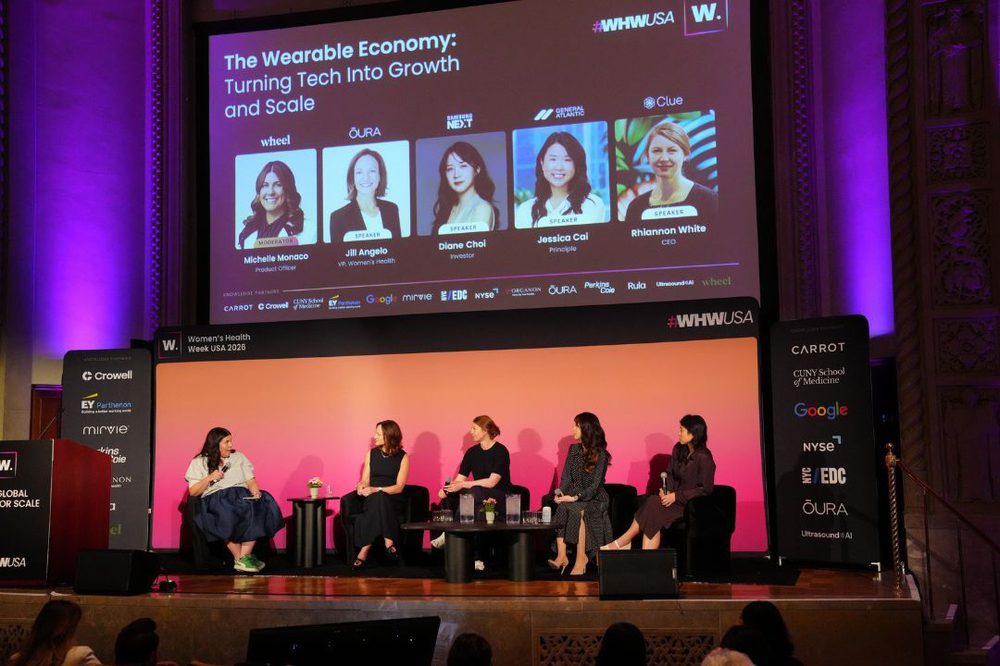
During the featured panel, “The Wearable Economy: Turning Tech Into Growth and Scale,” Wheel’s Chief Product Officer, Michelle Monaco, took the stage alongside industry pioneers:
- Rhiannon White, CEO at Clue
- Jill Angelo, VP of Women’s Health at Oura
- Diane Choi, Investor at Samsung Next
- Jessie Cai, Principal at General Atlantic
The panel explored a critical tension in modern femtech: consumer wearables and apps are generating more biometrics than ever before, but data alone does not equal care. To achieve true scale, the market must bridge the gap between consumer-facing discoveries and structured clinical execution.
Here are the four macro trends defining the next era of women’s health, guided by real-world data and insights from the front lines.
1. Wearables and AI need a Clinical Action Layer
We have entered an era where women possess an unprecedented amount of information about their own bodies. From sleep stages and heart rate variability (HRV) to detailed menstrual and perimenopausal symptom tracking, the consumer tech layer is robust.
However, as the panel highlighted, biometric tracking is only the start of the journey. AI can summarize patterns and consumer apps can flag anomalies, but an algorithm cannot write a prescription, order a metabolic lab panel, or manage clinical risk over a ten-year horizon.
The Strategic Takeaway: The ultimate value driver in virtual health is the clinical action layer. Consumer platforms capture the "pre-clinical" signals, but they require a seamless handoff to a unified clinical platform to triage, diagnose, prescribe, and provide continuous medical follow-up.
2. Women’s Health is the ultimate wedge into whole-person care
For too long, the healthcare ecosystem treated women’s health as a niche category tethered strictly to reproductive milestones. The consensus on the ground at Women's Health Week was clear: Women's health is whole-person care.
A woman navigating her 40s and 50s is not just experiencing isolated menopausal symptoms; she is managing an intersecting web of cardiometabolic risk, weight fluctuations, sleep disturbances, hypertension, and mental health changes. Enterprise giants from health plans to pharmaceutical leaders increasingly view cardiometabolic health as the commercially durable anchor for longitudinal care. Women’s health acts as the urgent, highly personalized wedge into that broader ecosystem.
Wheel’s data from the 2026 Virtual Care Horizons Report validates this exact behavioral trend:
- 50% of all virtual care visits are now driven by women's health.
- Women aged 43–58 represent the fastest growing female cohort on our platform, with utilization surging to 62%.
- When complex care like weight management is paired with integrated, multi condition chronic support, patient retention nearly doubles to 70% compared to a 50% industry average for access-only transactional models.
3. Bypassing a broken system: Portability, affordability, and consumer choice
Women are going outside of the old healthcare system because the old system simply does not work for them. Navigating limited local care and a lack of specialized menopause training can be challenging, leading many women to create their own supportive, self-guided health networks They are looking for true data portability where their wearable context moves with them. At the same time, they want frictionless economic paths, utilizing HSA/FSA cross-compatibility to bypass traditional reimbursement hurdles entirely.
Virtual care is no longer just a digital "front door" for quick prescription access; it has become a mid journey conversion layer where women actively seek resolution and a trusted, long-term clinical partner when the brick-and-mortar system fails them.
4. The enterprise imperative: Designing for ecosystem integration
For enterprise, health tracking applications, and life sciences brands looking to scale women's health initiatives in 2026, traditional commercial playbooks and legacy partnership models are no longer sufficient. Success requires an adoption and integration strategy.
Whether it’s embedding fulfillment partners like Amazon Pharmacy directly into the early stages of care pathway design, or deploying comprehensive rollouts within large, federated national organizations, infrastructure must be built to scale seamlessly from day one.
What this means for the future of virtual care
The signal from Women’s Health Week was clear: virtual care is moving beyond fragmented solutions. Consumers are generating more health data than ever, but the next challenge is turning those signals into clinical resolution.
Wheel helps health brands close that gap by connecting the consumer experience, clinical operations, nationwide clinician coverage, and data-driven insights needed to scale longitudinal care.
The future of virtual care will belong to brands that make care more connected, measurable, and easier to access. Contact us today to get started.
