Every Virtual Care Program Looks Good at Month One

Why virtual care retention, not enrollment, may be the metric that matters most in 2027.
In Q1, most of the weight management visits Wheel powered were first visits. By Q2, two-thirds were follow-ups. That inversion — and what it means for virtual care retention — matters more than any growth number in our first-half data.
If you run a virtual care program, you've probably had a quarter where the enrollment chart looked excellent. New patients up and to the right. Funnel healthy. The board slide wrote itself.
We spent the first half of 2026 looking at what happened after that first visit. The pattern was consistent enough to plan around, and it points somewhere uncomfortable: enrollment growth has become the easy part of the job. As access gets easier to replicate across the industry, patient retention in virtual care is emerging as the metric that actually separates programs.
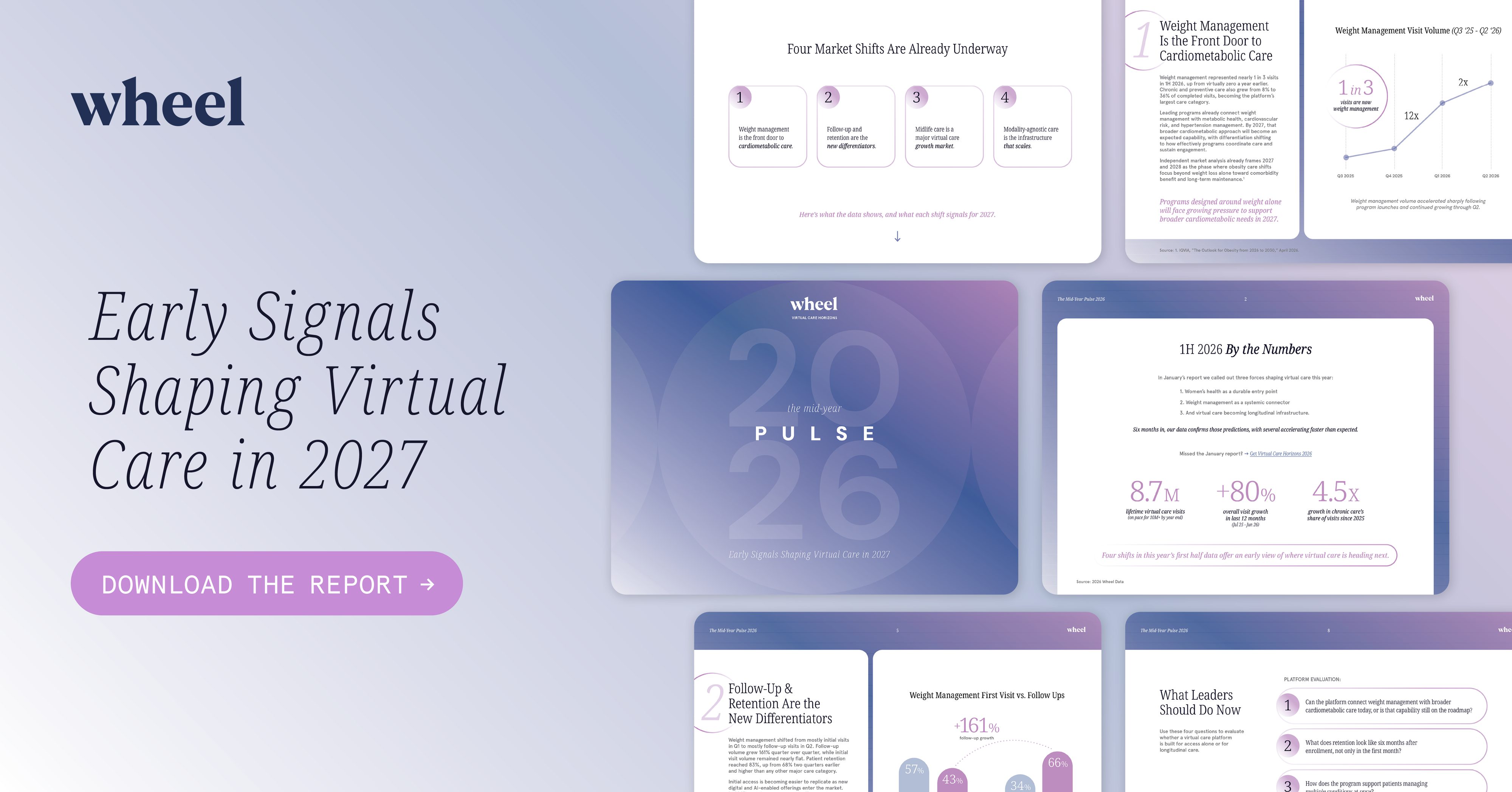
The Mid-Year Pulse 2026 covers four shifts already reshaping virtual care, with the quarter-by-quarter data behind each one.
Get the report →
The inversion: when follow-up visits become the majority
In Q1 2026, weight management visits split 57% initial and 43% follow-up. By Q2, that composition had flipped: 34% initial, 66% follow-up.
Follow-up volume grew 161% quarter over quarter. Initial visit volume stayed close to flat.
Those two numbers mislead separately and only make sense together. Acquisition did not slow down. The returning population compounded on top of a steady base until it became the majority of all activity in the category.
That is the shape of a program where patients stay.
It's also an operational change that tends to arrive before anyone has planned for it. When two-thirds of your volume is follow-up rather than intake, the work itself is different:
- Clinician capacity planning shifts, because follow-ups and first visits don't consume the same time or require the same context.
- Unit economics shift, because the cost to serve a returning patient and the cost to acquire a new one are not comparable numbers.
Programs built and staffed around intake volume tend to discover this the quarter after it happens.
Why thirty-day retention numbers can be misleading
Here's the structural problem with the metric most programs report.
The patients who complete an intake and return within thirty days are the most motivated cohort a program will ever have. They sought the program out, cleared whatever friction the signup process created, and acted on an intention that was fresh. A thirty-day return rate largely measures how good you were at enrolling motivated people.
That's worth understanding, but it's not the same as knowing whether the care model holds.
Month six measures something different. By then the initial motivation has been tested against ordinary life, and what keeps someone engaged has more to do with whether the program made continuing easy than with how badly they wanted it in January.
Almost every program has a good thirty-day number. Far fewer will show you month six, and the reluctance is itself informative.
What an 83% weight management retention rate tells us
Retention in weight management reached 83% from January through June 2026, up from 68% two quarters earlier, against 72% across all Wheel programs in the same period.
The direction is the interesting part. Retention usually degrades as a program scales, because the patients arriving later are less self-selected than the early adopters who went looking. The curve is supposed to bend down as volume grows.
Ours bent up. The gap between weight management and the platform average widened rather than narrowed while volume was climbing. Whatever is driving that is a property of how the care is structured, not a property of who happened to enroll first. That distinction matters commercially, because the first kind of advantage is repeatable and the second is not.
This is also where the category's clinical shape reinforces the pattern: ongoing monitoring, medication management, reassessment, and evolving cardiometabolic needs create repeated, legitimate reasons for a weight management patient to come back. For longitudinal virtual care programs like this one, continuity becomes the operating model. Enrollment tells you whether patients entered. Follow-up tells you whether care continued.
Where patient retention in virtual care breaks down
Programs rarely lose patients in a single dramatic moment. They lose them at transitions.
When the reason for care changes. A patient who started for one need, like weight management, and develops a second one, like hypertension or broader cardiometabolic risk, either gets routed somewhere that already has their history, or starts over as a new intake somewhere else. Most architectures quietly choose the second option.
When progress stalls. The period where results plateau is exactly when continuing requires the most support, and exactly when a program built around initial enthusiasm has the least to offer.
When continuing costs more effort than starting did. If the first visit took four minutes and every follow-up requires finding a synchronous slot three weeks out, the program has made returning harder than joining. Patients respond to that rationally. (It's part of why Wheel's H1 data showed asynchronous care growing faster than synchronous care. Matching modality to need reduces exactly this kind of friction.)
When context doesn't travel. A patient who has to re-explain their history at every visit is being asked to do the platform's work. That's a small friction that compounds across six months.
These are design problems rather than motivation problems, and design problems are easier to solve.
Why virtual care retention matters more as access expands
For years, much of virtual care's value proposition centered on access: how quickly can a patient get started, how easy is enrollment, how quickly can they reach a clinician. Those questions still matter but now they're becoming table stakes.
Why? Because access is getting cheaper to build.
Digital health funding reached $7.4 billion in the first half of 2026, with weight management the second most-funded clinical category. And new AI-enabled and digital-first entrants are launching intake experiences that are genuinely good, and they're launching them quickly.
When capital floods the front of the funnel, the front of the funnel stops being a differentiator. Now every serious program can acquire, so buyers need to start asking, who keeps the patients longitudinally?
That question is harder to dodge in a largely cash-pay environment, where a patient who stops returning has made an explicit judgment about value. There's no claims lag to hide behind and no benefit design holding them in place. They came back, or they didn't.
How to measure virtual care retention in your own program
If you want to know where you actually stand before someone else asks, three measurements will tell you most of it.
- Track retention by enrollment cohort, not in aggregate. Aggregate retention is the most commonly reported version and the least useful, because a growing program keeps refreshing the numerator with new enrollees. A program losing patients steadily can post a flat aggregate number for a year. Cohort curves at 30, 90, and 180 days can't hide that.
- Track follow-up as a share of total volume, quarterly. If that share isn't rising, the program is replacing, not compounding. Growth that comes entirely from new enrollment looks identical to durable growth on a total-visits chart and behaves nothing like it.
- Watch whether your best category's advantage widens or narrows as volume grows. If your strongest program's retention converges toward your average as it scales, the advantage was selection. If the gap holds or widens, it's structural. This is the single most diagnostic thing you can measure, and almost nobody measures it.
A retention number can rise for reasons that have nothing to do with whether the care holds. The number is useful only when it tells you something about the experience behind it.
If you know your own six-month curves cold, you're ahead of most of the market. If you don't, August is a better time to find out than a renewal conversation next year.
Virtual care trends in 2027 will extend beyond access
A lot of vendor conversations still center on enrollment velocity, time-to-first-visit, and total registered patients. Those metrics are real, and they're becoming table stakes. Two platforms with identical intake experiences will demo identically, and the demo is where most evaluations are effectively decided.
The programs holding enterprise contracts in 2027 will be the ones that can produce a six-month curve rather than a thirty-day one. The ones that can answer not just "how easy is it to start," but "what happens after access?" That's the real story behind virtual care trends 2027: access stops being the differentiator, and what happens next becomes the whole argument.
Wheel's first-half data suggests that, at least in weight management, continued care is becoming a much larger part of the growth story. Follow-up visits now make up the majority of weight management activity. Retention has increased. And the broader market continues to add new ways for patients to enter care.
The organizations best prepared for the next phase of virtual care will be able to do both: make it easy for patients to enter care, and build an experience designed to continue from there.
The Mid-Year Pulse 2026 covers this shift and three others already underway — weight management, cardiometabolic care, midlife demand, and virtual care infrastructure — each with the quarter-by-quarter data behind it and an early read on what it signals for 2027. Built from Wheel's utilization data across 8.7 million lifetime virtual care visits.
Sources: 2026 Wheel data, visits January to June 2026. Rock Health H1 2026 digital health funding analysis, reported via Fierce Healthcare, July 2026.
